Introduction
I don’t know how old I was when I asked my father why churches usually have a steeple. Five, or perhaps six. In any case, my father answered: ‘Steeples point to heaven. And the people who go to church like that idea.’ To my second question, why some modern churches don’t have a steeple, he said: ‘Because people no longer know exactly where heaven is.’
My father always had an answer for everything. That was very useful to me, especially in my early childhood. Later it became more difficult. Like me now, he suffered from insomnia. At night he read our school books, so that in the morning he could show us that he knew everything better than we did. He had always hoped that I would become a doctor like him, preferably a psychiatrist. But his competitive style didn’t exactly make that an attractive prospect. To make sure I could never become a doctor, I secretly dropped chemistry at grammar school. By the time he found out, it was too late. I hadn’t taken it for two years.
He did keep trying to outsmart me for quite a while. Well into my student years. But that stopped rather abruptly after I had left Heidegger’s Being and Time lying next to his armchair one evening, as if by accident. If there were a prize for the most impenetrable book ever written, I think Being and Time would stand a good chance. I had also underlined bits at random, just to confuse him even more.
In any case, I did not become a doctor, which also meant that in my career and later life I could only build on his knowledge and experience to a limited extent. And I have wandered around quite a bit in my career. Or really, even before that. I went from studying Chinese to political science, to philosophy, where in logic I finally found what I was looking for. And after that I moved from strategy consulting to entrepreneurship, to a management position at an internet company, to the profession of lobbyist, and later back to consultant, and entrepreneur, and director. I have worked on the world of the internet, the energy transition, education and sustainability. I have even had a dating company, and I am a shareholder in a beach bar.
Perhaps not thirteen misfortunes, but certainly a jack of all trades. So I am full of information and ideas. Sometimes useful, usually not. But I do think that I now understand things I would have liked to understand when I was twenty. And I would like to leave my children something. Because a large, perhaps too large, part of my life has taken place in my head, whatever I leave behind has to be in the realm of ideas. The amount of knowledge in the world is of course beyond comprehension, so it is almost impossible to know where to begin. But for me it begins with my sons Jan and Ebel. While writing, I went by what might be interesting to them.
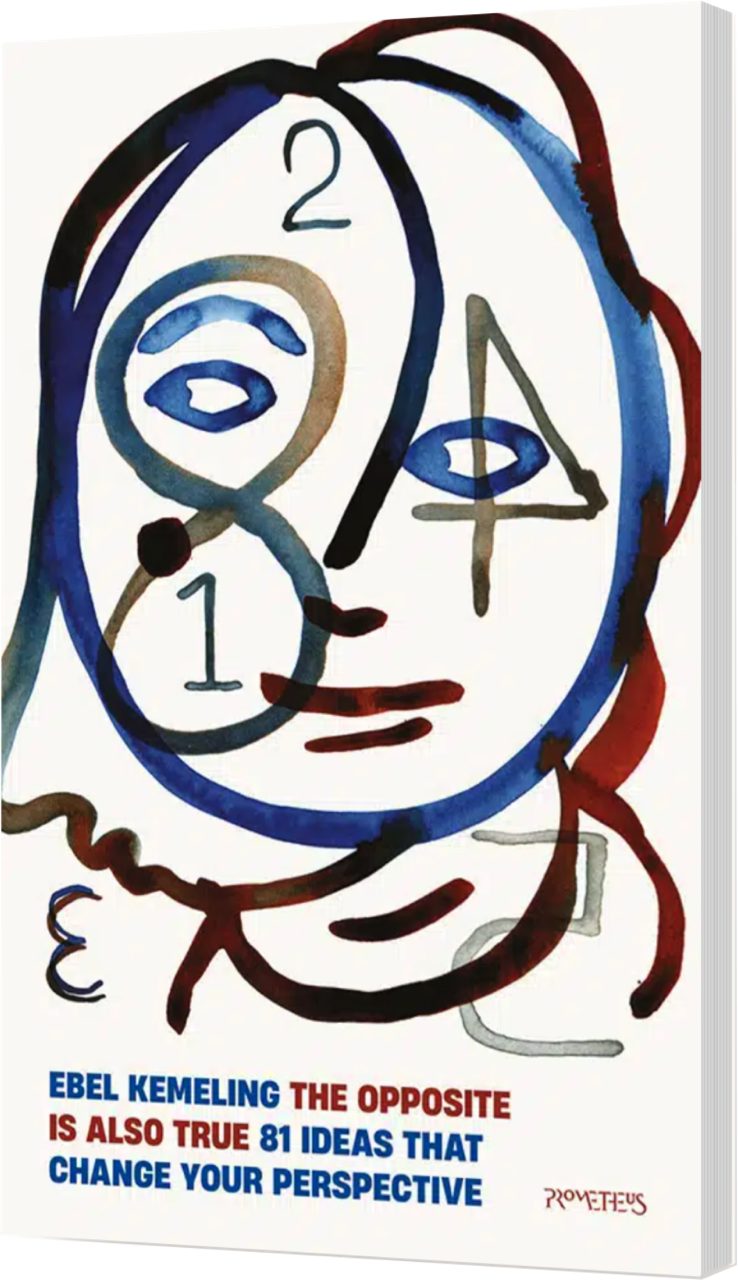
Using my own experiences, I try to find a number of regularities – or principles, or paradoxes – that more or less well-known scientists have written about. In the end there are 81 pieces. For Hindus a magical number, the square of 9, which ‘always returns to itself’ (the digits of any multiple of 9 always add up to 9). But that doesn’t make it any more logical than any other number.
What I do try to do is connect to my children’s world and sometimes refer to names or places we have seen together, or experiences we have shared. I can draw on a fairly large repertoire for that, because we travel a lot together and in 2021 and 2022 we spent some time travelling around Europe. Home schooling on the back seat from the school books, but also a great deal of knowledge in the wild. And with the Cruyffian advantage that, because of covid, all the top attractions in Europe were exceptionally quiet.
Like that trip, the subjects in the book are broad. The oldest idea dates from around 600 BC, the newest from last year. The pieces cover logic, mathematics, philosophy, economics, statistics, psychology and biology, and the thinkers come from all over Europe, the Middle East and the United States.
The most important criterion for including a particular scientific insight is above all whether I have encountered it in my own life and whether it has changed my own way of seeing things. In my descriptions I am not always entirely faithful to the aims and intentions of the thinkers I mention, but I try to show what I personally took from them. And as briefly as possible. That doesn’t always do justice to their ideas, but it all has to go a bit fast, because I have little patience. Something my sons may well have inherited from me.
I am not religious, I subscribe to no ideology, and I have no grand theory. An idea is often only of limited use. In some contexts you can do something with it and in others it is of no use at all. So all the pieces can be read independently of each other. But for me there is perhaps one common thread. In fact, it consists of three strands.
The first is that everything in the world is connected to everything else. That means that in your perspective – on anything at all – you must continually switch between the whole and the parts. If you want to understand something, you can look at how it is built up (the parts), but you can also ask what role it plays in a system (the whole). I like to emphasize that second approach, the systems view, mainly because it often provides new perspectives. That is because our culture and our education are steeped in the first way of looking – which you could also call reductionism. A great deal of good has come of that, so we certainly don’t want to lose it, but it is a limited perspective.
Secondly, our knowledge is always limited, either because the perspective falls short, or because our knowledge is always much simpler than the thing it is about. In other words, there is a great deal we do not know, and what we think we do know is often wrong.
Thirdly: if you look at the world mainly through systems glasses, you have to take into account that we ourselves are part of that same system. And that it is not possible to be part of something without influencing it. What often happens then is that an object suddenly becomes a subject, and the other way around. In other words, everything we see is about ourselves.
If you braid those three strands together, you arrive at the insight that from time to time we have to change our perspective. By that I don’t mean our view of the world or of life, but how you deal with a particular situation. Wittgenstein once wrote: ‘A man will be imprisoned in a room with a door that’s unlocked and opens inwards; as long as it does not occur to him to pull rather than push.’ When you get stuck, you often have to try something else. And sometimes you need a different mental model or idea for that.
It is not my intention to teach my children anything. First of all, I shouldn’t want to, because I know from experience how much resistance that can provoke. But it is also pointless. They are not going to do what they don’t want to do anyway. In the introduction to his Tractatus of 1922, Wittgenstein says: This book will perhaps only be understood by those who have themselves already thought the thoughts which are expressed in it – or similar thoughts. That is rather lofty for my little writings, but that is often how it goes in life. Texts, or other people, can help you, but what you really learn very often comes from yourself.
Cruyff knew that too, of course: you only start to see it once you get it.