
Theme: Economics & Business
Running a business successfully often means making use of existing patterns. You have to design things so that they work well. Once they are designed, they take on a life of their own that you cannot always manage. The same applies to economics. Much of policy is often a form of resistance against patterns inherent in how markets and services are designed.
Illustrations by Jan Rothuizen

Read an excerpt:
Jay Forrester – The structure of a system determines its behavior
I have been working on the energy transition for more than twenty years now and am involved with various companies in the solar industry. Since 2010, the industry has surged in Europe. However, in 2022, demand exploded. The war in Ukraine caused huge uncertainty around Russian supplies and gas prices went through the roof, prompting electricity to follow suit. European consumers responded by ordering solar panels en masse and the industry experienced unprecedented growth. This surge was exacerbated by government regulations and subsidies—adding even more reinforcing feedback.
But by mid-2023, the party was over. And with a hangover: there was such an excess of unsold reserves in the market that warehouses were bursting at the seams and manufacturers chose to ship some of their stock back to China. The demand, already huge, had been grossly overestimated.
How could that happen? We had seen a classic case of the ‘bullwhip’, a term introduced by Jay Forrester. Forrester was the founder of the scientific field of ‘system dynamics’, which considers how various components in a system affect each other and the system’s resulting behavior. To understand that behavior, you have to model it, something in which Forrester was a pioneer. Incidentally, modeling is not intended to predict but to illustrate how something works.
In 1961, he published Industrial Dynamics, which put forward a system for any company. Later, his work field expanded, as can be seen from later titles—Urban Dynamics (1969) and World Dynamics (1971). World Dynamics was an important basis for the Club of Rome’s Limits to Growth report, published in 1972.
In Industrial Dynamics, he explains how a company’s structure—policy, information flows, and decision-making—determines its success. Feedback loops play a major part in those information flows. He distinguishes two kinds: the balancing loop whose information tips the system back into balance, and the reinforcing loop, whose information bolsters a system’s response to an external stimulus. If this information loop is delayed, or a company doesn’t alter its policies to address this new information, a system can get unbalanced.
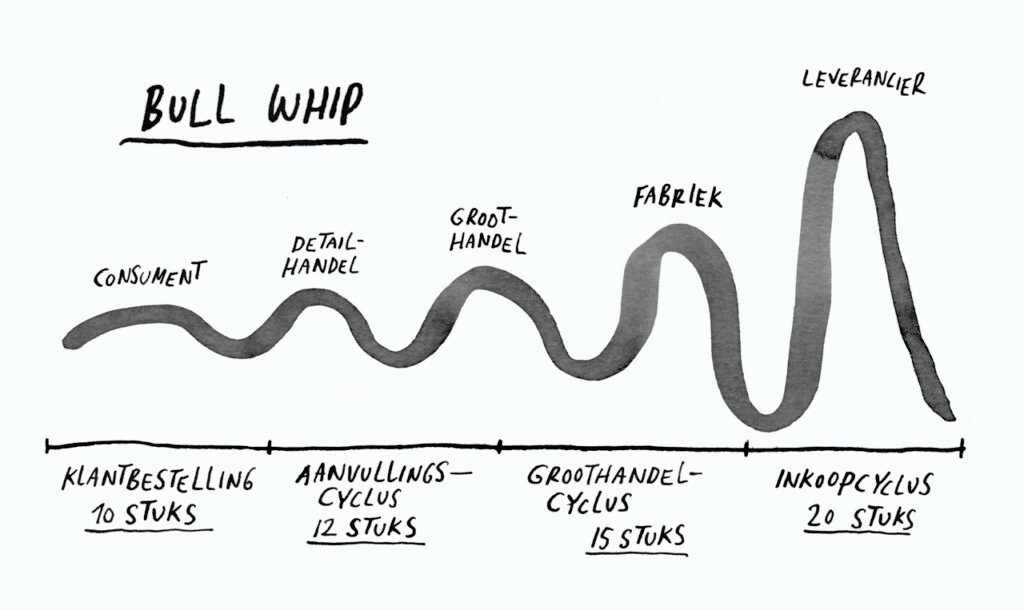
One example of that is a ‘bullwhip’. A whip cracks, because its very tip quite literally breaks the sound barrier. The speed at the tip is much greater than at the handle. Whips are tapered so that their mass decreases with their length. With a quick flick of the wrist, twenty kilometers an hour at the handle is accelerated to more than 1200 kilometers an hour at its tip. Fast enough to break the sound barrier.
A bullwhip is a good metaphor for what happens in the solar energy supply chain, which looks something like this: a customer orders from an installer, who orders from a distributor who then orders from a manufacturer. Imagine that in a normal situation, a hundred customers per week order solar panels, and suddenly, that number rises to a thousand customers per week. There are immediate shortages in the chain. The installers order one thousand panels from distributors, who are unable to fulfill the order. Manufacturers are also unable to fulfill distributors’ orders and shortages occur again, so they will soon scale up their production capacity. Preferably to more than a thousand panels a week, as the market could grow even more.
In turn, both installers and distributors will order more than they need to poach the existing stock from the competition. A combination of delays (because scaling up capacity takes time) and hoarding behavior ensures that the demand signaled by the customer is reinforced at every step of the chain. The feedback loops continue reinforcing for too long. And the bullwhip cracks at the other end of the supply chain, so the party most hurt is the manufacturer.
I like that you sometimes come across scientific concepts, like a bullwhip, in practice. It feels a bit like looking at a starry sky and recognizing some of the constellations. I have often seen bullwhips in my career, mostly on a lesser scale, in a single process, at a single company. But this bullwhip in the solar energy sector was gigantic and market wide.
What you will read in the book about Economics & Business:
Economics & business
Stanley Jevons – If we need less of something, we end up using more of it
Jean-Baptiste Say – Every supply creates its own demand
William Baumol – Prices of labor-intensive services and products rise faster than inflation
Montesquieu – The higher a country’s latitude, the wealthier it is
Herbert Simon – In complex situations, you work with heuristics
Theodore Wright (Walras, Christensen) – In the energy transition, solar has proven to be the most surprising
Stephen Harding – To be able to grow, organizations must be able to split
Jay Forrester – The structure of a system determines its behavior
Eli Goldratt – Operations management is the removal of bottlenecks
David Aaker – A brand is a collection of connotations held by its users
Barbara Minto – A good presentation follows the pyramid principle